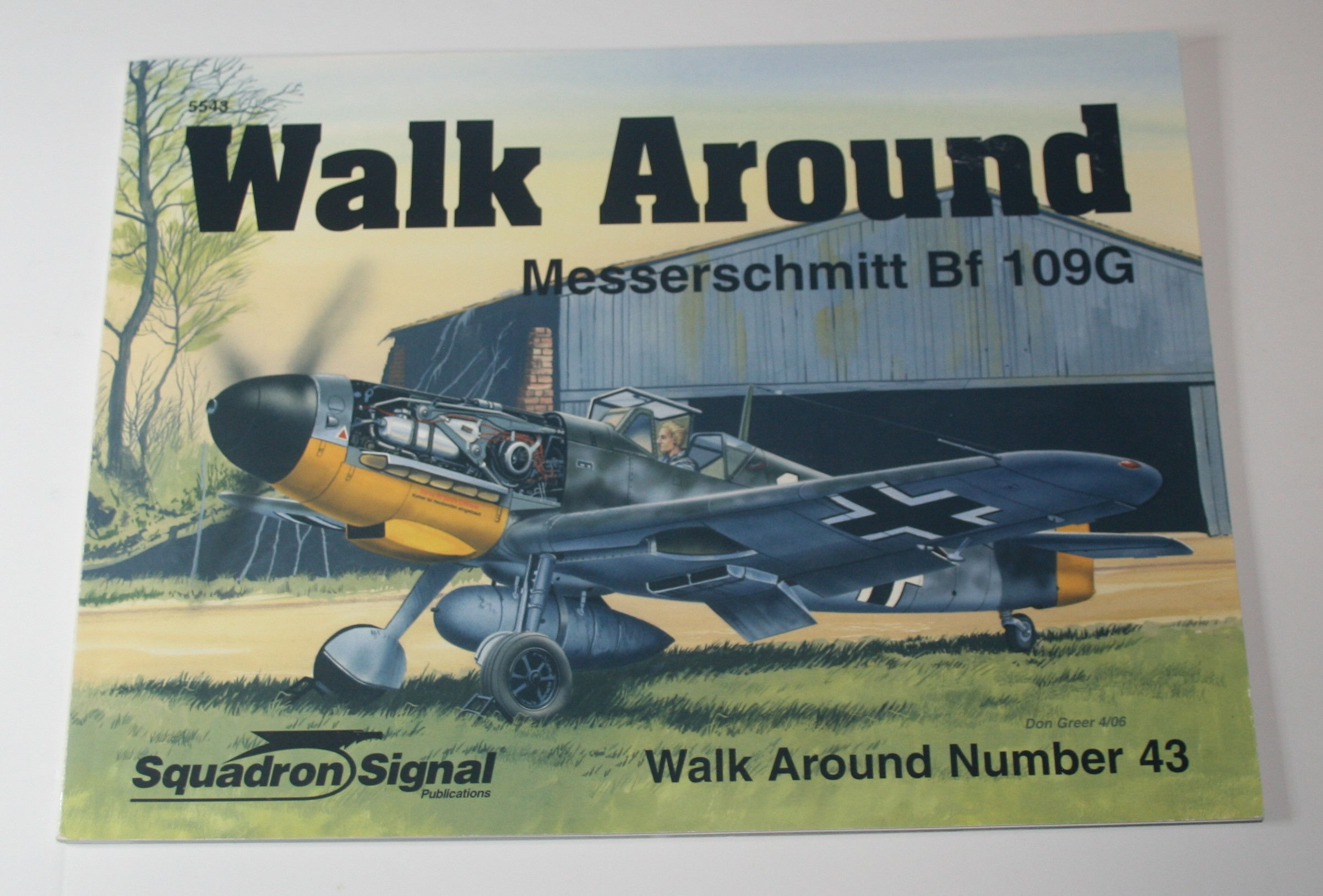
Messerschmitt Bf 109G Walk Around No. 43 By Hans-Heiri Stapfer Squadron/Signal
Messerschmitt Bf 109G Walk Around No. 43
By Hans-Heiri Stapfer
Squadron/Signal Walk Around Series
Commonly known as the “Gustav,” the Messerschmitt Bf 109G became the most widely produced version of Germany’s legendary WWII fighter. Introduced in 1942 with the more powerful Daimler-Benz DB 605 engine, the Gustav served on every major Luftwaffe front including Russia, North Africa, Italy, Western Europe, and the defense of Germany.
Hans-Heiri Stapfer’s Walk Around No. 43 focuses heavily on:
Cockpit detail photography
Engine and cowling panels
Landing gear and wheel wells
Armament installations
Canopy and fuselage variations
Camouflage and markings
Wartime and museum photography
Gustav production differences
Field modifications
Structural close-ups
The book contains:
Approximately 80 pages
Around 200 photographs
Color and black-and-white images
Large-format Squadron/Signal layout
Detailed variant coverage
The volume specifically covers:
G-1 and G-5 pressurized variants
G-2 and G-4 Eastern Front aircraft
The highly produced G-6
G-8 reconnaissance variants
Late-war Gustav developments
The book is especially valuable for modelers building:
Eduard Bf 109G series
Tamiya Bf 109G-6
Hasegawa Gustav kits
Revell Germany Bf 109G
Airfix Gustav variants
Luftwaffe late-war dioramas
Modelers and reviewers consistently praise:
Excellent close-up photography
Strong cockpit coverage
Useful camouflage references
Helpful wheel-well detail shots
Excellent panel-detail references
Good variant identification guidance
One retailer description highlights:
“200 wartime photos and 80 pages” of coverage.
The Gustav itself remains historically important because:
Approximately 23,000 Bf 109Gs were built
It served as the backbone of the Luftwaffe fighter force
Numerous ace pilots flew Gustav variants
The type evolved continuously throughout the war
The Bf 109G also became famous for:
Its powerful DB 605 engine
Heavy armament upgrades
Distinctive fuselage “bulges”
Exceptional climb performance
Challenging ground handling characteristics
Modelers frequently mention the book’s usefulness for:
Late-war Luftwaffe camouflage
Mottling patterns
Exhaust staining
Open-panel detailing
Cockpit super-detailing
Accurate Gustav variant identification
Collectors also note:
Hardcover editions command higher prices
Original Squadron printings are preferred
Workshop-used copies often show spine wear
Earlier printings generally have sharper photo contrast
Recommended Skill Level
Beginner to Advanced WWII aircraft modelers and aviation historians
Features
Squadron/Signal Walk Around Series No. 43
Written by Hans-Heiri Stapfer
Approximately 200 photographs
80-page format
Extensive cockpit references
Gustav variant coverage
Wartime and museum photography
Camouflage and markings references
Excellent modeling resource
For many Luftwaffe modelers, Bf 109G Walk Around No. 43 remains one of the most practical Gustav references because it provides exactly the kinds of close-up structural and camouflage images needed for accurate super-detailing and weathering projects.
